
SPOILER WARNING
I picked up the book on my father’s bedside table when I left my parents’ home to return to London in 2016. Someone had bought it for him when they had heard he was ill. Our Game, a le Carré from 1995 in the Penguin Modern Classics paberback edition. I began reading it as my train pulled away from a chilly, misty and sparsely peopled Darlington platform.
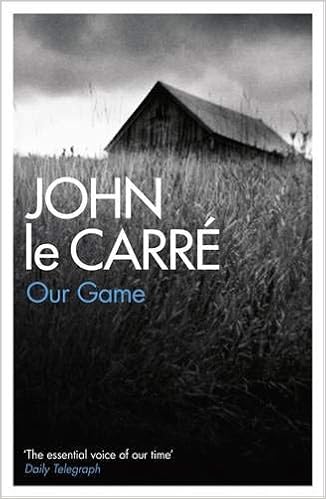
The narrative of Our Game orbits the relationship between Tim Cramner, a retired secret intelligence service desk officer, and Larry Pettifer, his agent, a charismatic and wild Winchester College chum whom Cramner ‘turned’ as a student. It is structured so that Larry is revealed only very gradually and through Pettifer’s memories: we have him first as voices on a phone and through aliases. We know that he has disappeared. We learn more as Cramner himself tries to piece together what has happened to his friend, talking to shared acquaintances and re-examining his own recollection; we learn of Larry’s backhanded courtship of Cramner’s younger lover Emma, an act that is equal parts revenge and whim; of their elopement; of the tense attraction between Tim and Larry, not quite sexual, but not quite chaste either (given the ambiguity of ‘turning’ we should hardly be surprised); and of Larry’s friendship with Checheyev, a maverick former KGB agent and loyal defender of the brutalised Ingush people.
Confession: I had never read a le Carré before. I had, snobbishly, thought that because it was so popular it couldn’t be so good. More fool me. On reading Our Game I was taken aback by how rich it was in complex and ambiguous motives, defined by the constant search for certainty: for moral certainty, for factual certainty, even for subjective certainty. It was an undertaking far more comprehensive than the telling of a spy story: this was a narrative driven by philosophical inquiry into the limits of knowledge in a shifting world. As I have read on into le Carré I have discovered the extent of this project: a half-century of surgical examination into the relationship between subjects and their states; into global geopolitics and morality, both collective, and individual.
I raced through Our Game, trailing Cranmer as he reconstituted the shape of a series of events from limited resources, a type of story I would come to realise was typical of the author. I read with haste until one morning, travelling to work on the tube, I reached p.123 and discovered the final corner my father had turned over, the point at which he had ceased to be able to read, a little upward tick triangulated from the bottom corner of the page; a material mark of the death of his faculty for reading that came a week or so before his physical death; a paper fish-hook.
-*-
In November, I returned North to visit my mum. I told her about the fact that I’d been reading the le Carré, told her that I was finding it comforting, a point of communion with my father. We spent half an hour kneeling in front of a bookcase talking about his reading habits. She told me that she remembered him being gifted a first edition by a friend who had worked at GCHQ in the 1960s and 70s. We dug around on the bookshelf and found it: The Honourable Schoolboy (1977). My mum told me to take it. There was also a hardback edition of Tinker, Tailor, Soldier, Spy (1974) and I took that as well. I began consciously pursuing my father into le Carré. Reading The Honourable Schoolboy this process found a name. This reading became a taking of ‘backbearings’; an attempt to establish the form of a compromised network through the patterning of its absence.
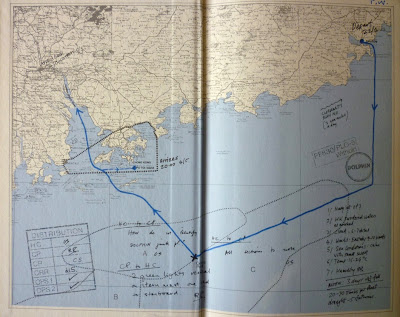
The Honourable Schoolboy – the least well known of the Karla trilogy – opens in Hong Kong and describes the withdrawal of the service from its home in the Colony, a withdrawal that has been compelled by the compromise of the Circus by Bill Hayden’s treachery. This narrative commences from a point of loss and describes the gradual rebuilding of the work of the Circus; the moment at which Smiley and his team switch from defence to attack:
His theory — he called it his premise — on how intelligence could be produced with no resources, was the subject of an informal meeting held in the rumpus room not two months after his accession.
I found it immediately useful to figure my own grief in this way, to think of myself as an agent in a network – in this instance, a family – attempting to produce intelligence with no resources – in my case, trying to think and feel my way around our loss. All such bereavements must be structured this way, the loss of no one person having been experienced by their loved ones before. I turned to these books for distraction, as intellectual stimulation, and in them I found a powerful emotional and psychological crutch.
The world of le Carré’s Circus is a world of family. Karla inserts the traitor Bill Haydon between George and his promiscuous wife Ann. Karla himself is finally pressured to defect through the discovery of his daughter, secreted in a Swiss sanatorium, a young woman driven mad by her father’s phantasmal existence. The novels are steeped in familial tragedies, betrayals, losses. As I began to map the shape of my grief I noticed that family relations provided more than explicit emotional background for the narratives but were metaphorically structural to the world of espionage le Carré described: the American secret services are “the cousins”; the women who work the Registry are “aunties.” When they run agents, George and Karla have a pastoral role as vicars and priests. The network of the secret world is translated into the more familiar and intimate terminology of the family.
-*-
At the close of Our Game, Cranmer has trailed Pettifer back to Ingushetia. He has made contact with Pettifer’s allies and is party to their experience of war. Pettifer himself is absent, as he has been throughout the novel, advancing backwards towards death. It is assumed that he has been killed but there are no remains to demonstrate the fact of his death one way or the other.
Cramner gives a rich eulogy to an assembly of Ingush villagers. It concludes with an expression of uncertainty that he has been understood:
“Whether Checheyev translated my words faithfully I never knew. Nor, if he did, how they were received by my audience, for another delegation was arriving and the ritual was already being repeated.”
Here was language as ritual: all that remained for Cramner was repetition. I thought of my own eulogy to my father, rehearsed as I wandered the garden, edited and checked with my mother, my brother and my wife. My growing suspicion that these novels, in working to reveal the sub rosa, to unconceal that which is occluded while veiling aspects of truth, are narrative treatises into death and mourning – that around which the only certainty is that the ritual will be repeated – was given a further shove two pages later:
A dead man is the worst enemy alive, I thought. You can’t alter his power over you. You can’t alter what you love or owe. And it’s too late to ask for his absolution. He has you beaten all ways up.
Then I remembered something Dee had said to me in Paris, and I had deliberately chosen not to hear: maybe you don’t want to find your friend, but to become him.

I met a friend whom I hadn’t seen since the summer, when we first discovered my father was ill. (I saw the same friend on Friday for the first time this year). I told him about my le Carré obsession. He recommended A Perfect Spy. “That’s the one you want. That’s the one about his father.”
-*-
For a while I worried at the Freudian elements in le Carré: the idea of all these family relations, the notion of the name of the father (I’d been teaching Jacques Lacan and at one stage I wondered if Oliver Lacon’s name was a nod to the psychoanalytic theorist), the ecumenical terms, state authority as the symbolic order, the intelligence services as its functionaries.
A Perfect Spy did little to dispel this angle to my reading, even as I resisted it. I knew it was a kind of academic sickness: who else but an Eng Lit academic would become obsessed with reading in this way? The problem was, A Perfect Spy was the perfect book for this, based as it is in le Carré’s relationship with his own father, Ronnie, a middle-class fraudster. The le Carré cypher in this novel, Magnus Pym, goes AWOL after his father’s death. His former colleague Jack Brotherhood (more family) remarks: “Rick’s dead so Magnus is free. He’s one of your Freudian types who can’t say “Father.” (80)
At the close of A Perfect Spy, Brotherhood is closing in on Pym. He arrives at the house of Syd, a proto-UKIPper, with a union jack on a flagpole in the front garden of his semi, and a former member of Rick’s court. In Syd’s front room there is an absence; a mark on the carpet where something recently stood. As readers, we know it’s the green filing cabinet that Magnus Pym has at his b&b, the same green filing cabinet that his father entrusted to him when he was arrested; that Magnus has previously broken into when it was stored in a cellar. In the Lacanian scheme we’d figure this as a ‘purloined letter’ but it is surely also an object that we can identify as a crypt: a locked storage vessel in which Rick has hidden from one and all – himself included? – the evidence of his criminality and the distress his nefarious misdeeds have caused; the filing cabinet of Rick’s unconscious.

Crypts take me in a slightly different re-reading of Freud. The crypt is the defining discovery of Nicholas Abraham and Maria Torok’s ‘renewal’ of psychoanalysis and the result of an extensive examination of the Wolfman case. It provides a model for visualising the no-place in the mind in which the traumatic event lodges itself:
‘The words that cannot be uttered, the scenes that cannot be recalled, the tears that cannot be shed – everything will be swallowed along with the trauma that led to the loss. Swallowed and preserved. Inexpressible mourning erects a secret tomb inside the subject.’
In order to access the crypt, in order, indeed, to locate it, they propose decryption of the language that oozes under analysis, language implicated in ‘the active destruction of representation’.
In a hinging point in A Perfect Spy that mirrors that of Edgar Allen Poe’s Purloined Letter, Syd gives away the significance of this absent object through his body language, by glancing at the mark on the carpet at the key point in Brotherhood’s interrogation. I’m very familiar with this lift: it’s one I myself have replicated and I’ve been expecting it. As I’d been reading the novel my eye had been drawn to two uses of the word ‘purloined.’[1]
Would an author versed in code-writing leave this material so carelessly scattered for the critic so minded to find it? Or, quite the reverse, is this not carefully scattered, just so the critic will find it? Is it the perfect cover; weaponised authorial misdirection? Is the letter hidden in plain sight?
-*-
John le Carré has remarked: ‘By inventing George Smiley I tried to conjure up the specter of my father.’ As any le Carré fan will know, my readerly wish for a clean exit for Smiley has been confounded numerous times. Smiley wasn’t finished at the end of Smiley’s People. Not only did he anchor the Secret Pilgrim, a loosely connected set of short stories, he was afforded a kind of deus ex machina role in 2016’s A Legacy of Spies, checking in by phone, that most haunted of media.
Over the years, David Cornwell has shared with his readers more of the detail of his relationship with his father. In an interview with Pierre Assouline in 1986 he discussed A Perfect Spy in noticeably Freudian terms:
We live much of our lives beneath the surface – like icebergs. Most of our thoughts and desires are unexpressed […] I finally realised I would not be able to write about my father until I was able to balance our respective guilt and responsibility […] The novel became a sort of catharsis. I exorcised my father. (86)

What is it, I wonder, that his work has offered me? I’m drawn to a line he turned in reference to the war photographer Don McCullin. It’s a useful gloss to what he’s really about.
In a grey, confused, elusive, ever-compromising world, he has the gall to think of life and death and the purpose of existence. (18)
This has been my discovery, care of that novel at my father’s bedside. That a literary project of fifty year’s standing that purports to be genre fiction, is in fact a grander undertaking. And where has it led?
In le Carre’s first novel, A Call for the Dead, he records ‘that secretly elevated state which immediately follows bereavement.’ (31) It is an astute description of something I have been fortunate enough to experience only once.
I can understand why father so liked le Carré. There’s great pathos but little sentimentality. Le Carré puts it this way:
The dead and nearly dead, like the mad, are free, but their freedom is no use to them. (19)
I continue into le Carré, religiously turning corners as I go.
[1] This seemed an incidence of this unusual word greater than one would expect in any novel, although it is entirely consistent with incidence in printed works of the period of approximately 0.0000135%. This seems rather more likely, therefore, to be an example of confirmation bias than the authorial direction I’d prefer it to be.

 Mark Blacklock