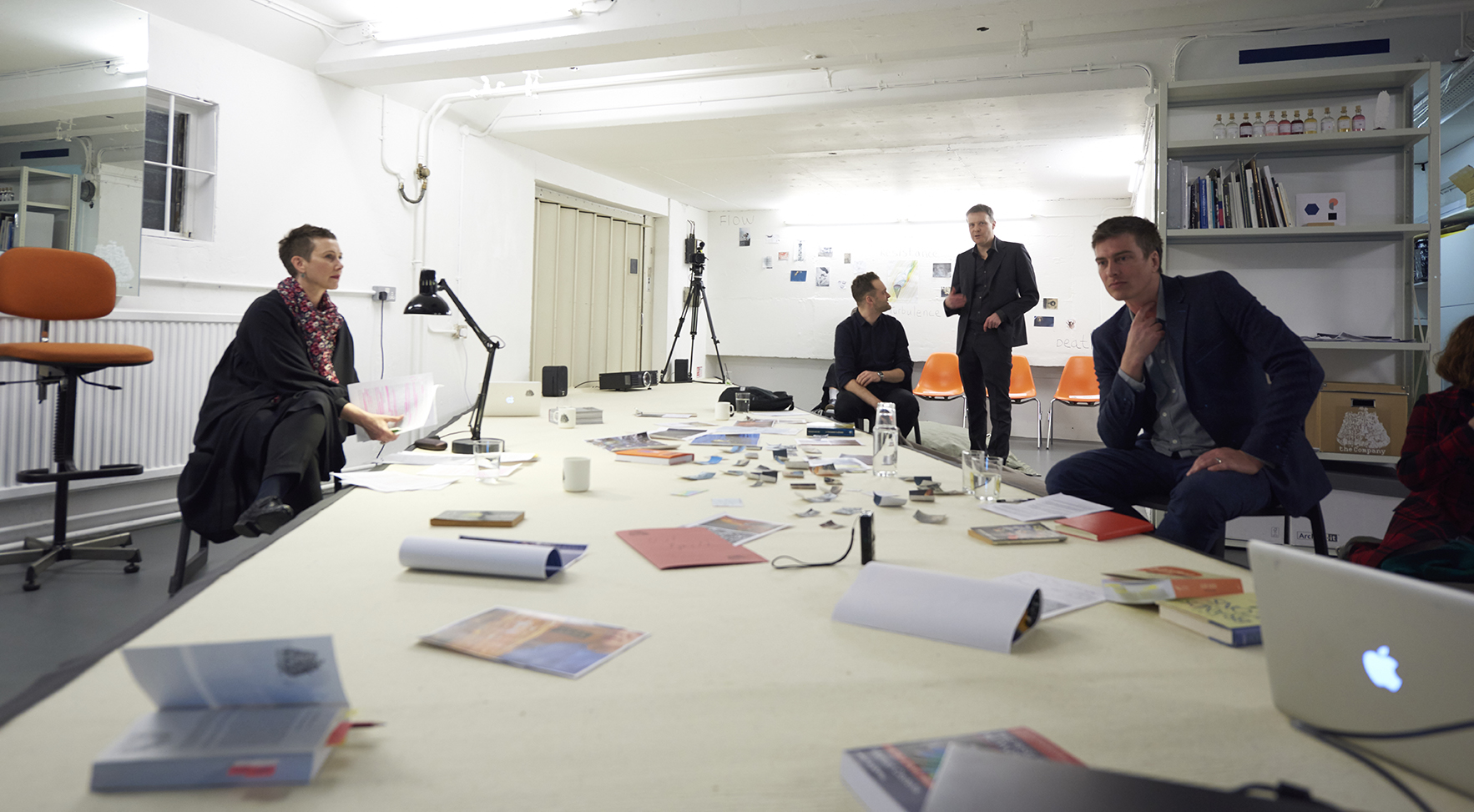
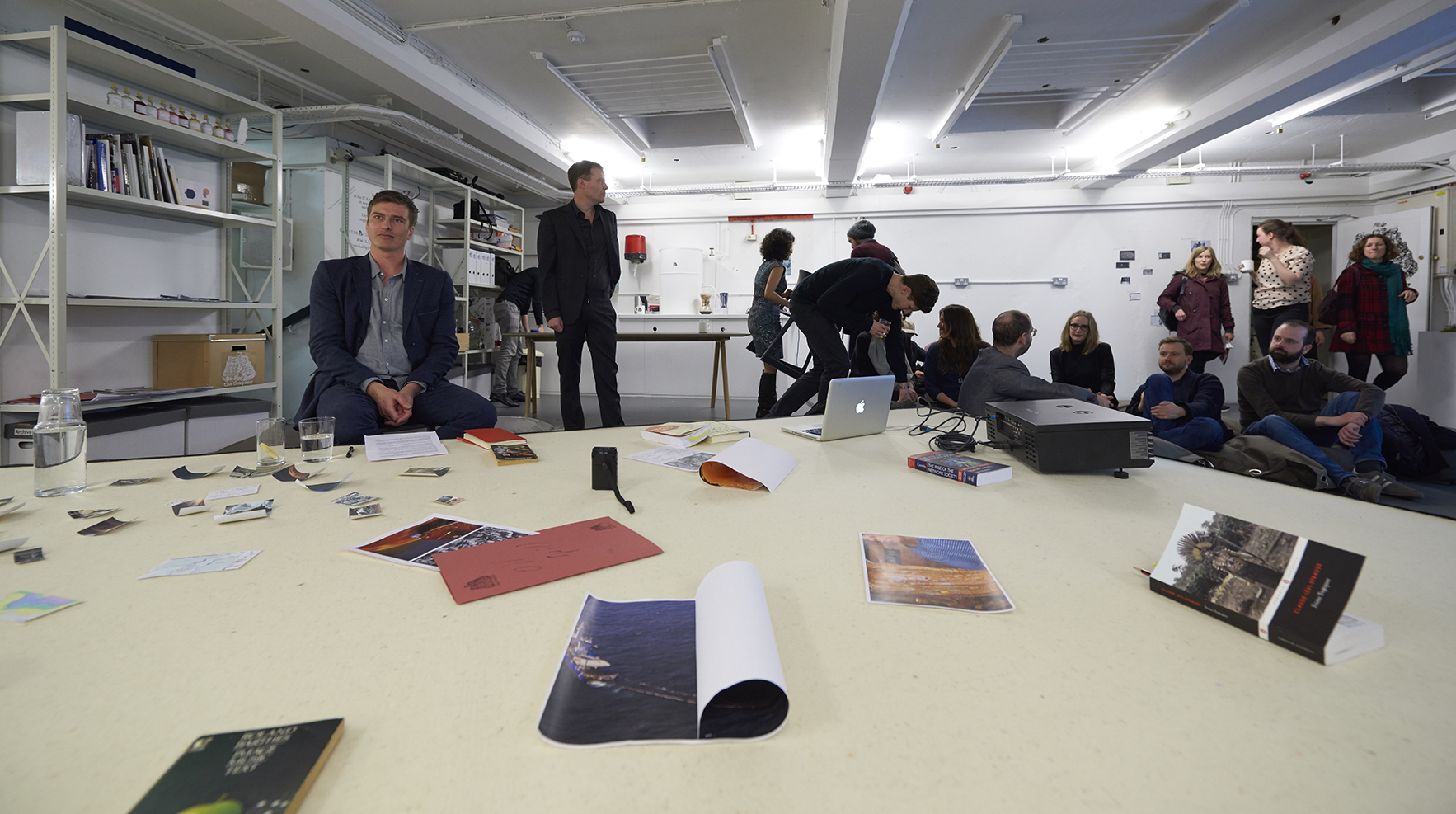
Island Hopping; or, an essay on several projections

©Sylvain_Deleu_Fig2_T_McCarthy_Think_Tank
Clémentine Deliss, Alfie Spencer, Tom McCarthy, Mark Blacklock ©Sylvain_Deleu_Fig2_T_McCarthy_Think_Tank
©Sylvain_Deleu_Fig2_T_McCarthy_Think_Tank

https://soundcloud.com/fig2/think-tank

As the representative of the literary point of our triangle, I’m going to offer some readings; perhaps reading is the term under which our distinct operations might find common ground. These will be in a hybrid mode, part literary history, part in response to theoretical writing, and in the spirit of our engagement I’ve gone to anthropological thinkers: hopefully anthropological thinkers amenable to literature. I hope the nature of the engagement with corporate culture will become apparent.

I’m grateful that Tom invited me to “fail interestingly” in attempting this triangulation, although, somewhat like U., I became anxious that I might be unable to do even that. In my desperation I went to Marc Augé’s Anthropology of Supermodernity, which may be familiar to some here. There I found two images that resonated particularly powerfully in terms of Satin Island. Augé’s remark that for an anthropologist ‘the ideal vantage point is the deck of a ship putting to sea’ which put me in mind of Satin Island’s closing scene. And his final sentence, a call for an ethnology of solitude.

So I’m going to be alighting not directly upon Satin Island but upon other islands. I realised that material I was looking at in a different context might offer a useful model for thinking our triangle and an ethnology of an earlier form of solitude. Specifically:
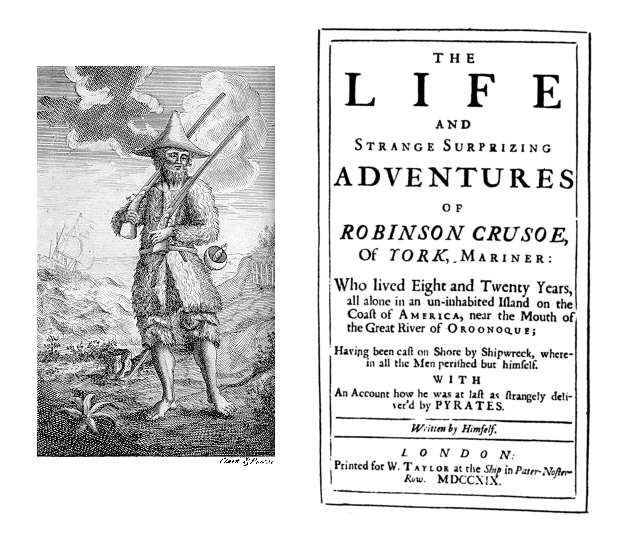
Robinson_Cruose_1719_1st_edition

The Life and Strange Surprizing Adventures of Robinson Crusoe, Of York, Mariner: Who lived Eight and Twenty Years, all alone in an un-inhabited Island on the Coast of America, near the Mouth of the Great River of Oroonoque; Having been cast on Shore by Shipwreck, wherein all the Men perished but himself. With An Account how he was at last as strangely deliver’d by Pyrates

How so? Well, Robinson Crusoe is frequently thought of as a pioneer of the realist novel. Crusoe himself is often read as an archetypal homo economicus, an exemplary liberal capitalist at the birth of liberal capitalism – an impression enhanced by the frequency with which his island has been used as a model by political economists. Certainly, Crusoe is a capitalist: a sailor first, but very soon a trader, a merchant, a plantation owner, and a slaver; a corporatist. He experiences a series of encounters with ethnic others – North Africans, West Africans, native central Americans – and in this he is, perhaps, also an anthropologist avant la lettre.

So Crusoe emerges from the nexus of the flourishing of global trade and the ‘present tense’ encounter with alien cultures accelerated by improvements in cartography.

crusoe_map

The Farther Adventures of Robinson Crusoe, published later in 1719 to monopolise on the popularity of the first story, included a map of his routes: the trade routes of the period, essentially, but perhaps not so far from the routes taken by Levi Strauss 250 years later. My crash course in cartography identifies that as an azimuthal stereographic projection map, by the way. Stereographic projection maintains angles between meridians but area becomes distorted. Perhaps we can return to the distortions of maps later, a subject I know is of interest to Tom.

Crusoe also emerges in the context of an information boom: a local, English language boom, provoked by the repeal of the copyright acts in 1695. Crusoe may well be a liberal capitalist, but I’d like to suggest that he participates in this field as a processor of information.

As Karl Marx wrote of him in Das Kapital:

having rescued a watch, ledger, and pen and ink from the wreck, [he] commences, like a true-born Briton, to keep a set of books. His stock-book contains a list of the objects of utility that belong to him, of the operations necessary for their production; and lastly, of the labour time that definite quantities of those objects have, on an average, cost him.

We should note well that ledger. For the nineteenth century scholar Mary Poovey, double-entry book-keeping is a significant textual staging post in a new epistemological mode that insists upon abstraction and quantification; the purification, following Bruno Latour, of nature from society. As a book-keeper Crusoe is a participant in this emergent, modern subjectivity: master of a nature he reduces to information.

For Michel de Certeau, another interested reader of Crusoe, this same epistemological shift is characterised as the establishment of a scriptural economy. For De Certeau, Crusoe masters the island, nature, a blank space, and also the blank space of the page, in his ledgers and his journal.

De Certeau reads the first sign of the other – the footprints on the beach – as the rupture of wild, untamed orality into Crusoe’s ordered space. This is highly suggestive.

Tables and lists abound. Information is processed, yes, but so too is information’s other – noise – established. In his Essay on Several Projects, published at the beginning of the 18th century, Defoe made a number of claims that might interest us here. He declared the 18th century to be the projecting age, and gave the true definition of a project as ‘a vast undertaking, too big to be managed.’

He also had something to say on spoken English: he favoured a plain style, and described words without sense as ‘Noise, which any brute can make as well as we and birds much better.’ Many readers of Crusoe have remarked upon his first companion on the island, his parrot Poll, who repeats his name back to him. But it’s not just Poll. Crusoe catches and tames two further parrots, which he also teaches his name. He makes corporate the production of noise. He sets up his own feedback loop, one in which the signifier of his subjectivity is made into, in Defoe’s own words, noise.

Indeed, once you start reading the novel in informational terms intriguing details begin to present themselves. In one fit of paranoia, Crusoe digs an escape route from his cave that emerges in his own garden. He fashions himself a physical, spatial loop around which he crawls. And then there’s my favourite informational table: the list of the ways in which 23 cannibals are killed. All of whose bodies are buried on the beach, and about whom no more is said. Crusoe and Friday make a record of their slaughter, and then make the island into a vast tomb. I wonder if these curiosities don’t express an anxiety in the text about the modern liberal subject’s attempt to process information, a return of repressed noise insistent within processes of purification.

Versions of the story – Robinsonades – have proliferated. It’s a particularly noisy text. I’d like to embark briefly on a curiously overlooked Robinsonade as a staging post on the way to Satin Island.

ConcreteIsland

J.G. Ballard’s Concrete Island. A triangular island, no less, closed off by the thundering traffic of the Westway, and into which the architect Robert Maitland plunges in crashing his Jaguar. The triangular model is also extended to the structure of his social relations with the two other inhabitants of the island, a pre-literate tramp called Proctor and a prostitute, Jane Sheppard. Alfie, I suspect that Maitland is corporate culture in this triangle; Clementine, why not have Proctor for anthropology and I’ll take Jane Sheppard for literature.

I’d like to draw attention to a couple of details: the three sleep in the crypt of a church that is sealed into this overdetermined space, a space teeming with multiple presents, a surrealist assemblage of times that reflects the disordered state of Maitland’s psyche.

Concrete Island is consciously modelled on Crusoe – Maitland creates an island ‘estate’ from the ruins of his Jag – and sets the model for Ballard’s late fictions of enclosed communities in which psychopathologies are let run riot. Of particular interest is the chapter in which Maitland pretends to teach Proctor to write, has him copy out messages requesting help in the hope of attracting the attention of passing motorists under the pretence of teaching him how to write his name.

“He began to scrawl the letters across the concrete with both hands. Each word he started in the centre, moving outwards to left and right. ‘Again, Proctor!’ Maitland shouted above the roar of a truck climbing the feeder road. In his excitement the tramp was garbling the letters together into an indecipherable mass.”

Maitland’s scriptural machine – another human subject – produces noise where signal should be. Indeed, Maitland wants noise. Proctor simply gives him the wrong kind.

What do these examples tell us about literature’s relationship to capitalism and to anthropology? Perhaps the distinction was always bogus, another purification that can’t be repressed. Literature offers itself as a site for speculative anthropology; it can reach from the here and the now into the there and the then, the where and the when; it won’t bring back facts, or real encounters, but it can select its objects with freedom and model systems of relations that are yet to come into being. Corporate culture perhaps already does this on our behalf. It surely, as was the case with Crusoe, describes new terrains.

I want to offer a new form of projection as a possibility for the future relationship of literature, anthropology and corporate culture. In fact, it’s a hybrid of two types of projection. Triangulation, as a method for measuring space, was superseded by satellite imagery in the 1980s. Essentially, one point of the triangle has been cast into orbit. In truth, triangulation originated in the stars, and so it has returned, with force.
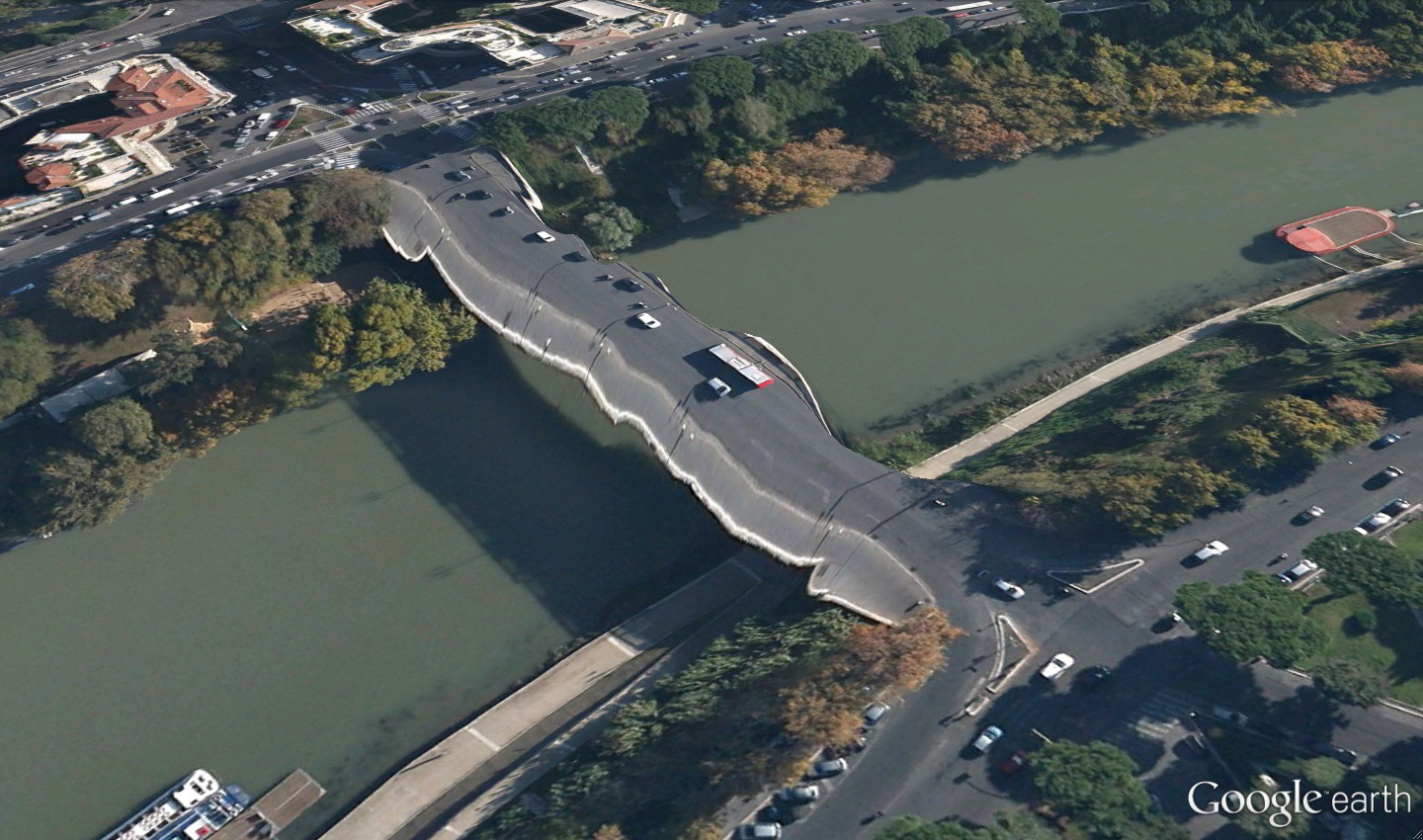
post_google1

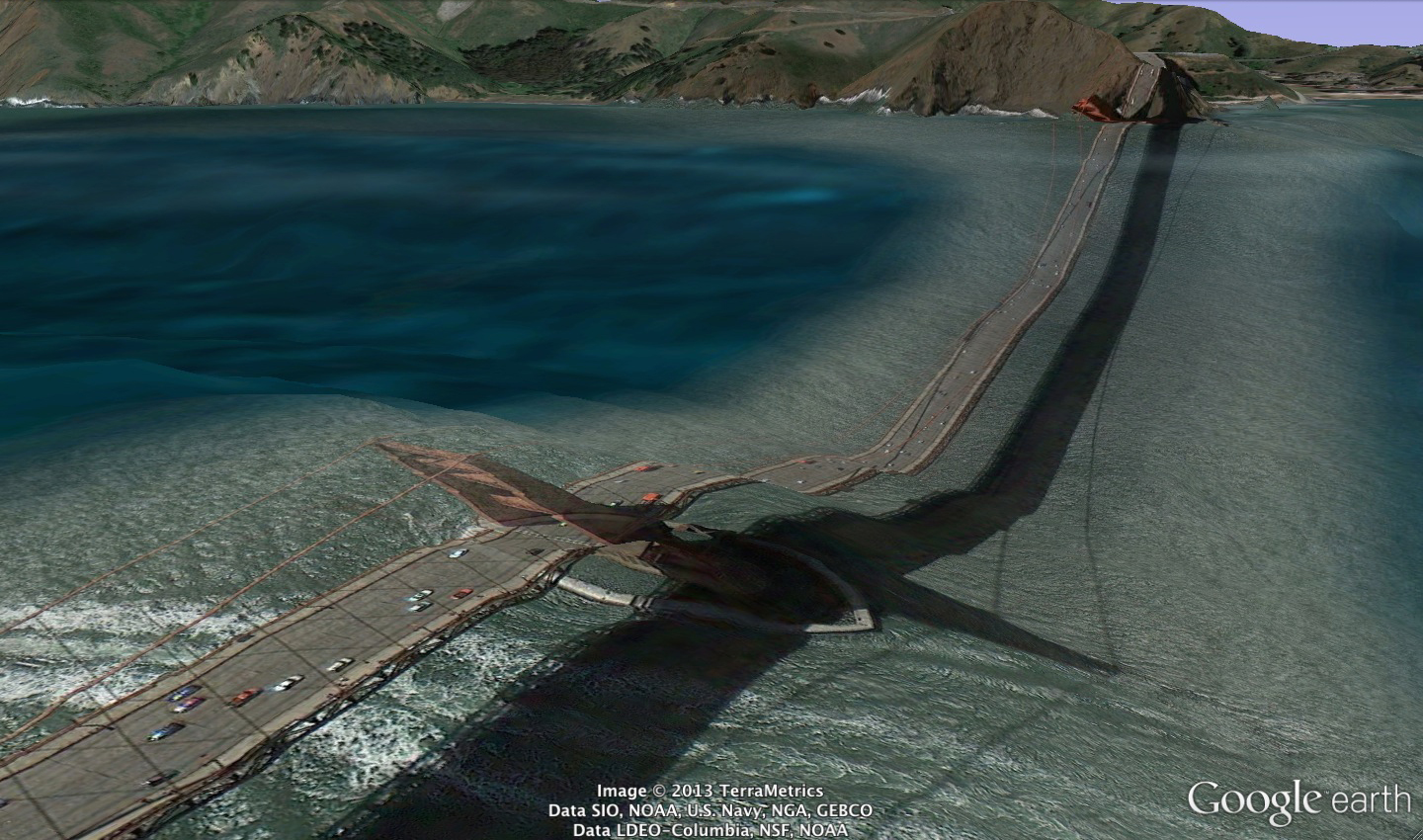
In Postcards from Google earth the artist Clement Valla documents anomalies in the satellite imagery produced by Google. Essentially, these are artefacts produced by the hybrid of algorithms used by Google for marrying the planar photographic imagery generated by its satellites and the complicated topology of the surface of the earth. In truth, the failing is perceptual – we read depth cues in the photographs that the algos don’t. Yet. Google call this the Universal Texture. These images seem to me fulfil the wilder aims of the cubists, to visualise two distinct spatial perspectives in the same plane. We might also think these with De Certeau, as a totalizing representation of space achieved from a godlike perspective.
post_google2

I wonder if this form of noise, produced through a corporation processing impossible volumes of information, doesn’t map a new projective landscape into which literature and anthropology might strike, into which we might follow De Certeau’s calls to return to street street level. To what new islands might these roads take us? And more importantly, what kinds of subjects might inhabit them?

(Paper given at ‘Think Tank’, Tom McCarthy’s installation at the ICA as part of fig-2 in March 2015. We were limited to 15 minutes, the same amount of time McCarthy’s character U. has in which to give his interesting but ultimately baffling conference presentation in Satin Island.)

At the Site Gallery

Culture-jamming has a long and venerable history. The essay ‘Le détournement comme négation et comme prelude,’ originally published in Internationale Situationniste #3 (Paris, December 1959), described the favoured Situationist tactic of détournement quite simply as ‘the reuse of preexisting artistic elements in a new ensemble.’ In practical terms, that implied, but was not limited to, ‘correcting’ an earlier work or ‘integrating’ disruptive elements into it.

The users’ guide ‘Mode d’emploi du détournement,’ written by Gil Wolman and Guy Debord in the pre-Situationist year of 1956, provided specific laws and clarified: ‘The mutual interference of two worlds of feeling, or the juxtaposition of two independent expressions, supersedes the original elements and produces a synthetic organization of greater efficacy. Anything can be used.’ The User’s Guide identified Duchamp’s painting of a moustache on the Joconde as ‘old hat’ and suggested that the advertising industry produced the most effective détournement unconsciously.

In the late 1970s and 1980s various artists in the San Francisco Bay area of the west coast of America updated the practice of détournement for the Reagan-era. The Billboard Liberation Front set about its mission of ‘the timely improvement of outdoor advertising,’ altering existing ads to subvert their messages to anti-corporate slogans. Negativland’s 1984 tape release JamCon ‘84, an imagined audio documentary from a convention of ‘Jammers,’ collaged material from the group’s Over the Edge radio show, coining the idea of ‘cultural jamming’ as a kind of experimental radio piracy and intervention into commercial radio. Negativland gained considerable notoriety for their release of a recording that spliced a sweary out-take of DJ Casey Kasem with a low-fi cover of U2s I Still Haven’t Found What I’m Looking For.

In the early 1990s, cultural jamming was smoothed into culture-jamming and popularised by the critic Mark Dery, who wrote about Negativland in a series of articles and essays. A key publisher of Dery’s work was Adbusters, the magazine published from Toronto that gave a focal point to the ‘subvertising’ tradition that endured through the anti-capitalist movement of the 90s and later fed into Occupy.

How, then, to update these assorted theoretical positions and guerrilla media practices for the era of surveillance capitalism, whose structure derives from massive online data collection and psychometric profiling to enable targeted digital advertising? That’s one question posed by an installation piece by the pseudonymous Bill Posters (will he or won’t he be prosecuted?) and Dr Daniel Howe. Spectre, named after the online persona of Dr. Aleksandr Kogan, the data scientist who sold 87 million Facebook profiles to Cambridge Analytica (‘Titles themselves,’ wrote Gilman and Debord, ‘are a basic element of détournement’), occupies a space somewhere between an interactive museum touchscreen – ‘swipe right to hear the sound of a zither’ – and the kinds of interactive advertising envisaged in dystopian, near-future SF.

Six black monoliths, 2.5 metres high, face inwards on a circular pedestal, shades of Kubrick, a nod to LeWitt, and strong echoes of the Neolithic henge monuments lurking behind those. Gallery visitors face each monolith, with their backs to the centre of the circle, as if participating in a ritual. Set into each monolith is a screen.

Instructions on the screen invite participants to build a tailored digital-influencing campaign – not before being required to enter their email addresses, an input that acquires an unanticipated queasiness in this unfamiliar context. Selecting datasets from which to target a group of potential voters – credit scores, social media activity, web histories, the cookie crumbs of data surveillance capitalists have been hoovering up for decades – and splicing these with psychometric profiles gleaned from the kinds of tests Kogan had Facebook users taking for fun, the interactive element of the piece allows gallery visitors to put together a political ad targeted to our audience, designed to sway them whichever way we want. If you’re a Farage in waiting, you can paste emotive slogans about control onto images of columns of refugees.

The final section of the on-screen process has caused something of a stir. So-called deep fake videos manipulate a selection of ‘celebrity influencers’ from the worlds of media, art and politics, into endorsing Spectre: Donald Trump, Morgan Freeman, Kim Kardashian (‘when there’s so many haters, I really don’t care, because their data has made me rich beyond my wildest dreams’), Marcel Duchamp (still old hat) and Marina Abramovich (obsessed with death).

When Posters distributed these clips through his Instagram account they went gratifyingly viral, attracting global media attention, despite the fact that they show the present shortcomings of the technology every bit as much as its potential: the mouths don’t quite move as they should – a ventriloquist would not be impressed with the video lip-sync on Freeman – and the Video Dialogue Replacement (VDR) is only as good as the impressionist hired – you’ll hear a better Trump any day on R4. Nevertheless, having Mark Zuckerberg declare his love of profiting from your data on a platform owned by Facebook is a neat gag (interestingly, Youtube have removed the same clips for copyright violation, while they remain on Insta).

There is a strong sense of the original spirit of détournement in the emerging technology of the deepfake – Debord and Gilman wrote that ‘it is obviously in the realm of the cinema that détournement can attain its greatest effectiveness and, for those concerned with this aspect, its greatest beauty.’ The replacing of original with manipulated audio in documentary and news footage arouses considerable fear and suspicion, making this a timely intervention. The biggest questions surround who has access to the tech. Spectre was made in collaboration with CannyAI, a Tel Aviv-based advertising agency. Evidently, the advertisers remain at the front line, albeit more consciously than in the 1950s.

Back in the gallery space, the work is not quite as effective. As is often the case with claims for ‘immersion’, the experience of the piece is no more immersive than using a tablet with headphones, and this might highlight the challenges faced by subvertising in the digital era: surveillance capitalism is already, everywhere immersive and where Wolman and Debord celebrated the low cost of détournement, the barrier to entry in the digital sphere is far higher and the resources of the competition commensurately greater.

The question of how much knowledge can be assumed of audience members in relation to the very idea of how tech companies make their money and seek to influence behaviour is also live. Spectre assumes only a little knowledge, and so a slightly heavy hand leads an LRB-reader through the interactive elements of the on-screen experience that one suspects digital capitalists would disdain: it is, perhaps, insufficiently gamified.

Posters comes from a street art background – the Billboard Liberation Front have been co-opted as street artists after the fact – and this tendency towards the didactic is a persistent failing in that medium, too. I’m reminded of Charlie Brooker’s curt dismissal of Banksy as a “pseudo-subversive” preacher. Certainly, the blunter end of the practice is some way from the subtleties Debord envisaged.

It is striking that the most high-profile culture jamming in contemporary Britain is the more traditional anti-Brexit billboard campaign of the group Led by Donkeys, that re-presents the incriminating tweets of Leave-facing politicians in guerrilla billboard campaigns. The suspicion persists that the gallery context is simply too formal an environment for techniques derived from Situationist practice. Wolman and Debord further envisioned an ultra-détournement that would operate in everyday life. The surveillance capitalists, it seems fair to say, have got there first.

(Hail Spectre! at Site Gallery during Sheffield Doc Fest, June 2019)

Warp at 30

Warp records has rewired me. In 1991, two years after the label launched, I was a student in Sheffield. Bleep techno was environmental in Sheffield in 1991, the year after LFO had reached number 12 in the charts. Local heads had known Fon, the record shop from which the label was born, for years: the first track ever released by Warp was by an act named after the Forgemasters factory you saw from the train as you came in from Leeds.

Newer arrivals to the republic of SoYo heard bleep at house parties, where there was always some geezer in a back-room playing DJ Mink and Sweet Exorcist while the jump-up styles of local DJs Astrix and Space – watch yer bassbins, I’m tellin ya! – played in the front; I went to NYSushi, a club-night I associated with Warp because they had Designer’s Republic-designed flyers, and wobbled about to the programmed soul of Nightmares on Wax in the early part of the evening.

Aphex Twin woozed into my world the following year. One of only two CDs I owned was Selected Ambient Works, a perfect record to listen to on CD, endlessly loopable into the lysergic dawn: a record not actually released by Warp but one that seems to have become a Warp release by osmosis. With the Artificial Intelligence comp they put out that same year Warp became pioneers of what would morph into IDM and sure enough, 1993 saw Aphex find his second home at Warp with his Polygon Window album. Only four years in and already Warp were owning multiple styles of techno.

While the tones of SAW were deeply woven through 1992, it was also the year I procured some “second-hand” 1210s from a Sheffield friend whose brother had “sourced” them in Bradford. I started buying 12” vinyl too: Coco, Steel and Lovebomb, Kid Unknown. My friend Rory hammered Lex Loofah. These records underpin the Warp sound: bass heavy, a fusion of the deep, bin-rattling tones of electro records that DJs like Parrot had been spinning with the rave that was occupying the north.

By the time I was in London in 1996 I’d become a music writer, largely because of a burgeoning obsession with this kind of music. While I’d bought more progressive house tracks than one person should ever own in the previous years, I’d picked up a few more Warp 12”s along the way. Joey Beltram in a Designer’s Republic sleeve; Weatherall’s Sabres of Paradise haunting the dancehall; Autechre’s increasing abstraction. Warp was like a honeypot for inventive, dedicated, electronic music artists and the relationship with the Designer’s Republic ensured that there was always a shard of the future, unevenly distributed, jagging out from Sheff.

The years 95-96 were a hot streak for Aphex on Warp: Donkey Rhubarb, the Girl Boy EP, the Richard D. James album. I remember weeping, hungover, in a car at 8am, driving through Streatham listening to Milkman. I remember sifting through the racks at Beggar’s Banquet in Putney, wondering if I could afford to become a Warp completist: I wanted all those purple sleeves and it was only the fact that not all of them were purple sleeves that saved me. I bought the Mike Inc. Paroles twinpack there and discovered a trak that absolutely kills to this day. Warp has always had a backbone of choice, dancefloor-slaying techno.

The curiosity and exploration, meanwhile, was veering in all directions: Finnish lounge-techno hepcat Jimi Tenor on 7” – they were early to the smaller format revival, natch; the bassline-heavy, backroom smoke-jazz of Red Snapper; insane Max Tundra electronic freestyles. It felt like every single release was essential. I was introduced to Richard James at a RePhresh night at the Soundshaft and bumped into him again skulking through the back streets around Elephant. I met label founder Rob Mitchell in Rough Trade in Notting Hill and fanboyed him. He was an absolute gent. I almost met Bjork at a Warp party at Elektrowerkz that Rob gave me a pass to: Mark Bell of LFO was producing her stuff. I had slipmats that informed me We Are Reasonable People. I played Autechre alongside a pre-Actress Darren Cunningham on an internet radio station broadcasting from under the arches in Old Street: “Nice’n glitchy!” It’s safe to say I was a groupie.

1999 saw the Aphex boom. Come to Daddy followed by Windowlicker, a double whammy that shifted the gears of Electronica into sports mode. Alien future music, thrash and funk. Viral image distortion that infected the United States. There was always a sense that they knew how best to nourish the vision of their artists. By this time Squarepusher was also a Warp artist and they protected him from interview – no need to protect Aphex, who just didn’t show up or spat back chewed up text collages. Autechre had begun their steady domination of underground digital musics. I interviewed Jamie Lidell at their offices, now in Kentish Town. The move to London made them no less urgent. Fuck, we’d all moved to London.

I even stuck with them through Maximo Park. If Warp was putting it out, I’d have a listen. I’m still quite fond of it because they’re geordies, but it doesn’t stand up so well, that one. Warp had branched out into film without missing a beat but the resurgence of guitar music was trickier to navigate. The post-punk revival lured them towards the rocks but the twenty-year anniversary releases in 2009 showcased what was already a frankly astonishing back catalogue. I wept again, joyously, at Milkman, this time covered by Born Ruffians in a stomp-folk style. Autechre reworked LFO in a dream-team pairing.

I gave up on the dream of being a completist back in the late 90s and it’s just as well because they’ve put out more than 400 records since, but I still cane Warp like no other label. They keep drawing those bees to the pot, remaining one step ahead, describing the landscape of the most innovative electronic music in the most emergent and idiosyncratic styles. OneOhTrixPointNever, Gaika, Kelela, Fly Lo, Lorenzo Senni. Brian Eno, ffs. And still Aphex, Authechre, Nightmares on Wax.

Warp records make up about 10 per cent of my record collection and gave the blueprint for much of the rest. And now they’re 30 and weirdly it makes me feel timeless rather than old or young; it makes me feel like I’m still riding that shard of the future.

A spine of techno, dancefloor killlers. LFO’s Freak. Have that. That’s my dancefloor, right there.

(June 2019, unpublished)