Island Hopping; or, an Essay upon Several Projections

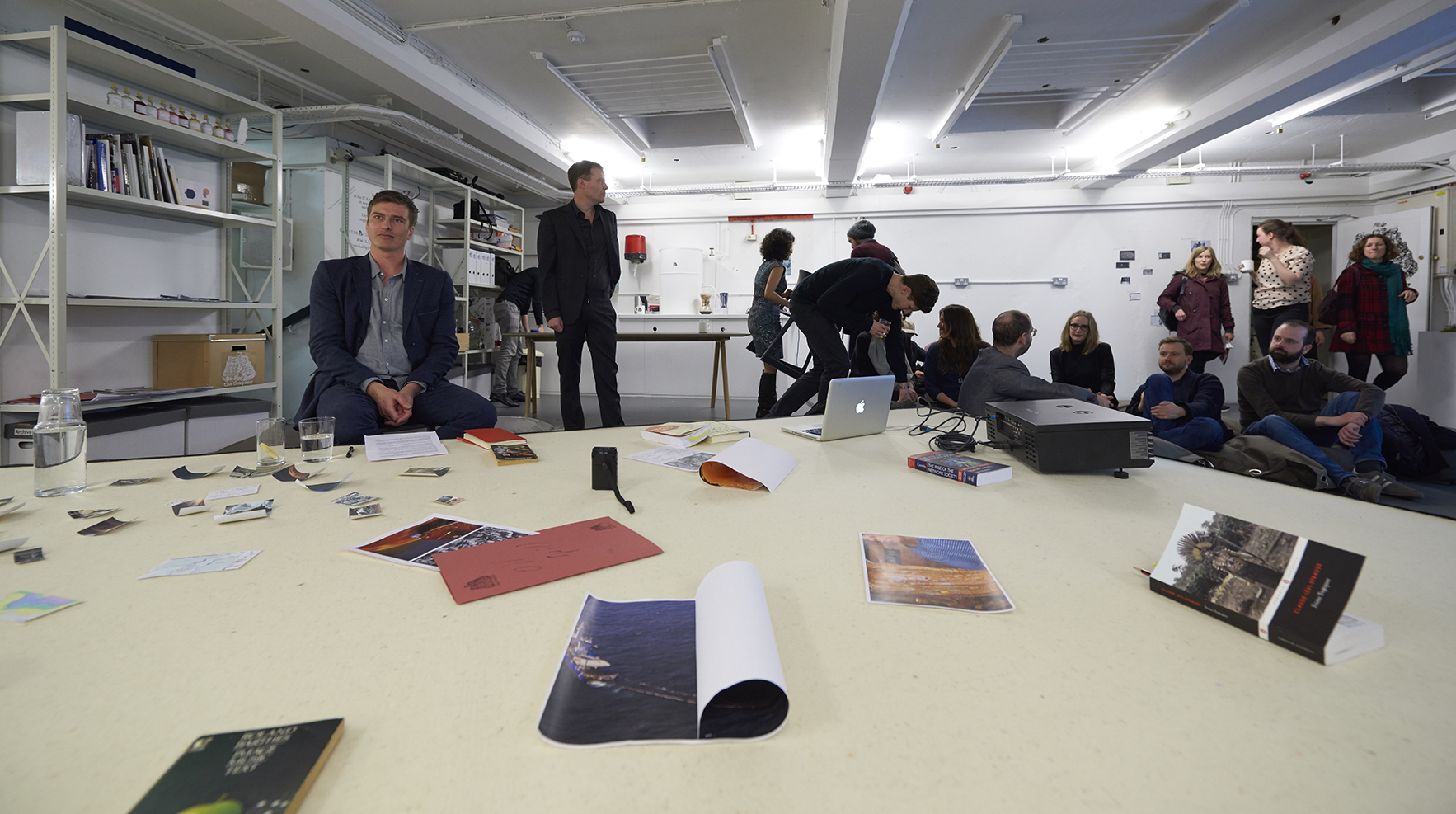
Some images and audio from last Thursday evening’s ‘Think Tank’, part of Tom McCarthy’s installation at the ICA as part of fig-2. With many thanks to Tom and Fatoş Üstek for inviting me to participate, my co-panellists Clémentine Deliss and Alfie Spencer and all those who attended. The text of my talk is below – we were limited to 15 minutes, the same amount of time U. has in which to give his interesting but ultimately baffling conference presentation in Satin Island. I hope to ‘archipelagise’ this at some point and to fill out the elisions.
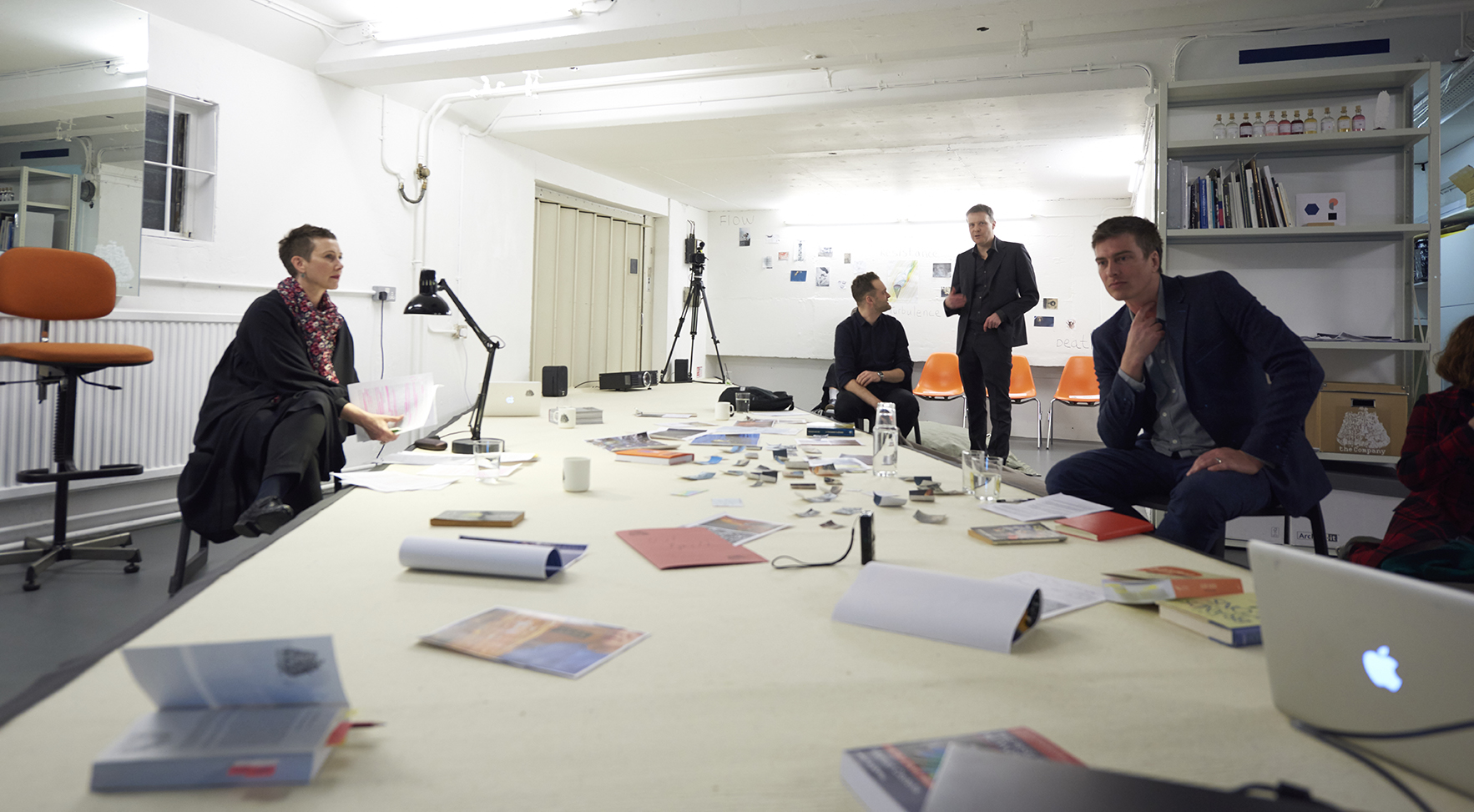
©Sylvain_Deleu_Fig2_T_McCarthy_Think_Tank

https://soundcloud.com/fig2/think-tank

As the representative of the literary point of our triangle, I’m going to offer some readings; perhaps reading is the term under which our distinct operations might find common ground. These will be in a hybrid mode, part literary history, part in response to theoretical writing, and in the spirit of our engagement I’ve gone to anthropological thinkers: hopefully anthropological thinkers amenable to literature. I hope the nature of the engagement with corporate culture will become apparent.

I’m grateful that Tom invited me to “fail interestingly” in attempting this triangulation, although, somewhat like U., I became anxious that I might be unable to do even that. In my desperation I went to Marc Augé’s Anthropology of Supermodernity, which may be familiar to some here. There I found two images that resonated particularly powerfully in terms of Satin Island. Augé’s remark that for an anthropologist ‘the ideal vantage point is the deck of a ship putting to sea’ which put me in mind of Satin Island’s closing scene. And his final sentence, a call for an ethnology of solitude.

So I’m going to be alighting not directly upon Satin Island but upon other islands. I realised that material I was looking at in a different context might offer a useful model for thinking our triangle and an ethnology of an earlier form of solitude. Specifically:
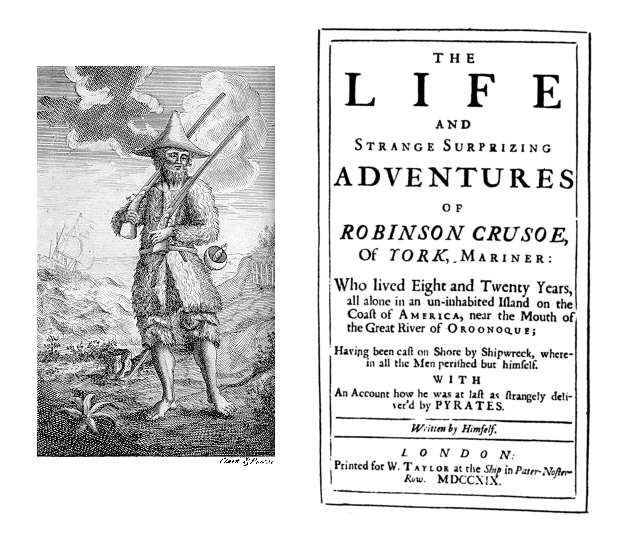
Robinson_Cruose_1719_1st_edition

The Life and Strange Surprizing Adventures of Robinson Crusoe, Of York, Mariner: Who lived Eight and Twenty Years, all alone in an un-inhabited Island on the Coast of America, near the Mouth of the Great River of Oroonoque; Having been cast on Shore by Shipwreck, wherein all the Men perished but himself. With An Account how he was at last as strangely deliver’d by Pyrates

How so? Well, Robinson Crusoe is frequently thought of as a pioneer of the realist novel. Crusoe himself is often read as an archetypal homo economicus, an exemplary liberal capitalist at the birth of liberal capitalism – an impression enhanced by the frequency with which his island has been used as a model by political economists. Certainly, Crusoe is a capitalist: a sailor first, but very soon a trader, a merchant, a plantation owner, and a slaver; a corporatist. He experiences a series of encounters with ethnic others – North Africans, West Africans, native central Americans – and in this he is, perhaps, also an anthropologist avant la lettre.

So Crusoe emerges from the nexus of the flourishing of global trade and the ‘present tense’ encounter with alien cultures accelerated by improvements in cartography.

crusoe_map

The Farther Adventures of Robinson Crusoe, published later in 1719 to monopolise on the popularity of the first story, included a map of his routes: the trade routes of the period, essentially, but perhaps not so far from the routes taken by Levi Strauss 250 years later. My crash course in cartography identifies that as an azimuthal stereographic projection map, by the way. Stereographic projection maintains angles between meridians but area becomes distorted. Perhaps we can return to the distortions of maps later, a subject I know is of interest to Tom.

Crusoe also emerges in the context of an information boom: a local, English language boom, provoked by the repeal of the copyright acts in 1695. Crusoe may well be a liberal capitalist, but I’d like to suggest that he participates in this field as a processor of information.

As Karl Marx wrote of him in Das Kapital:

having rescued a watch, ledger, and pen and ink from the wreck, [he] commences, like a true-born Briton, to keep a set of books. His stock-book contains a list of the objects of utility that belong to him, of the operations necessary for their production; and lastly, of the labour time that definite quantities of those objects have, on an average, cost him.

We should note well that ledger. For the nineteenth century scholar Mary Poovey, double-entry book-keeping is a significant textual staging post in a new epistemological mode that insists upon abstraction and quantification; the purification, following Bruno Latour, of nature from society. As a book-keeper Crusoe is a participant in this emergent, modern subjectivity: master of a nature he reduces to information.

For Michel de Certeau, another interested reader of Crusoe, this same epistemological shift is characterised as the establishment of a scriptural economy. For De Certeau, Crusoe masters the island, nature, a blank space, and also the blank space of the page, in his ledgers and his journal.

De Certeau reads the first sign of the other – the footprints on the beach – as the rupture of wild, untamed orality into Crusoe’s ordered space. This is highly suggestive.

Tables and lists abound. Information is processed, yes, but so too is information’s other – noise – established. In his Essay on Several Projects, published at the beginning of the 18th century, Defoe made a number of claims that might interest us here. He declared the 18th century to be the projecting age, and gave the true definition of a project as ‘a vast undertaking, too big to be managed.’

He also had something to say on spoken English: he favoured a plain style, and described words without sense as ‘Noise, which any brute can make as well as we and birds much better.’ Many readers of Crusoe have remarked upon his first companion on the island, his parrot Poll, who repeats his name back to him. But it’s not just Poll. Crusoe catches and tames two further parrots, which he also teaches his name. He makes corporate the production of noise. He sets up his own feedback loop, one in which the signifier of his subjectivity is made into, in Defoe’s own words, noise.

Indeed, once you start reading the novel in informational terms intriguing details begin to present themselves. In one fit of paranoia, Crusoe digs an escape route from his cave that emerges in his own garden. He fashions himself a physical, spatial loop around which he crawls. And then there’s my favourite informational table: the list of the ways in which 23 cannibals are killed. All of whose bodies are buried on the beach, and about whom no more is said. Crusoe and Friday make a record of their slaughter, and then make the island into a vast tomb. I wonder if these curiosities don’t express an anxiety in the text about the modern liberal subject’s attempt to process information, a return of repressed noise insistent within processes of purification.

Versions of the story – Robinsonades – have proliferated. It’s a particularly noisy text. I’d like to embark briefly on a curiously overlooked Robinsonade as a staging post on the way to Satin Island.

ConcreteIsland

J.G. Ballard’s Concrete Island. A triangular island, no less, closed off by the thundering traffic of the Westway, and into which the architect Robert Maitland plunges in crashing his Jaguar. The triangular model is also extended to the structure of his social relations with the two other inhabitants of the island, a pre-literate tramp called Proctor and a prostitute, Jane Sheppard. Alfie, I suspect that Maitland is corporate culture in this triangle; Clementine, why not have Proctor for anthropology and I’ll take Jane Sheppard for literature.

I’d like to draw attention to a couple of details: the three sleep in the crypt of a church that is sealed into this overdetermined space, a space teeming with multiple presents, a surrealist assemblage of times that reflects the disordered state of Maitland’s psyche.

Concrete Island is consciously modelled on Crusoe – Maitland creates an island ‘estate’ from the ruins of his Jag – and sets the model for Ballard’s late fictions of enclosed communities in which psychopathologies are let run riot. Of particular interest is the chapter in which Maitland pretends to teach Proctor to write, has him copy out messages requesting help in the hope of attracting the attention of passing motorists under the pretence of teaching him how to write his name.

“He began to scrawl the letters across the concrete with both hands. Each word he started in the centre, moving outwards to left and right.

‘Again, Proctor!’ Maitland shouted above the roar of a truck climbing the feeder road. In his excitement the tramp was garbling the letters together into an indecipherable mass.”

Maitland’s scriptural machine – another human subject – produces noise where signal should be. Indeed, Maitland wants noise. Proctor simply gives him the wrong kind.

What do these examples tell us about literature’s relationship to capitalism and to anthropology? Perhaps the distinction was always bogus, another purification that can’t be repressed. Literature offers itself as a site for speculative anthropology; it can reach from the here and the now into the there and the then, the where and the when; it won’t bring back facts, or real encounters, but it can select its objects with freedom and model systems of relations that are yet to come into being. Corporate culture perhaps already does this on our behalf. It surely, as was the case with Crusoe, describes new terrains.

I want to offer a new form of projection as a possibility for the future relationship of literature, anthropology and corporate culture. In fact, it’s a hybrid of two types of projection. Triangulation, as a method for measuring space, was superseded by satellite imagery in the 1980s. Essentially, one point of the triangle has been cast into orbit. In truth, triangulation originated in the stars, and so it has returned, with force.
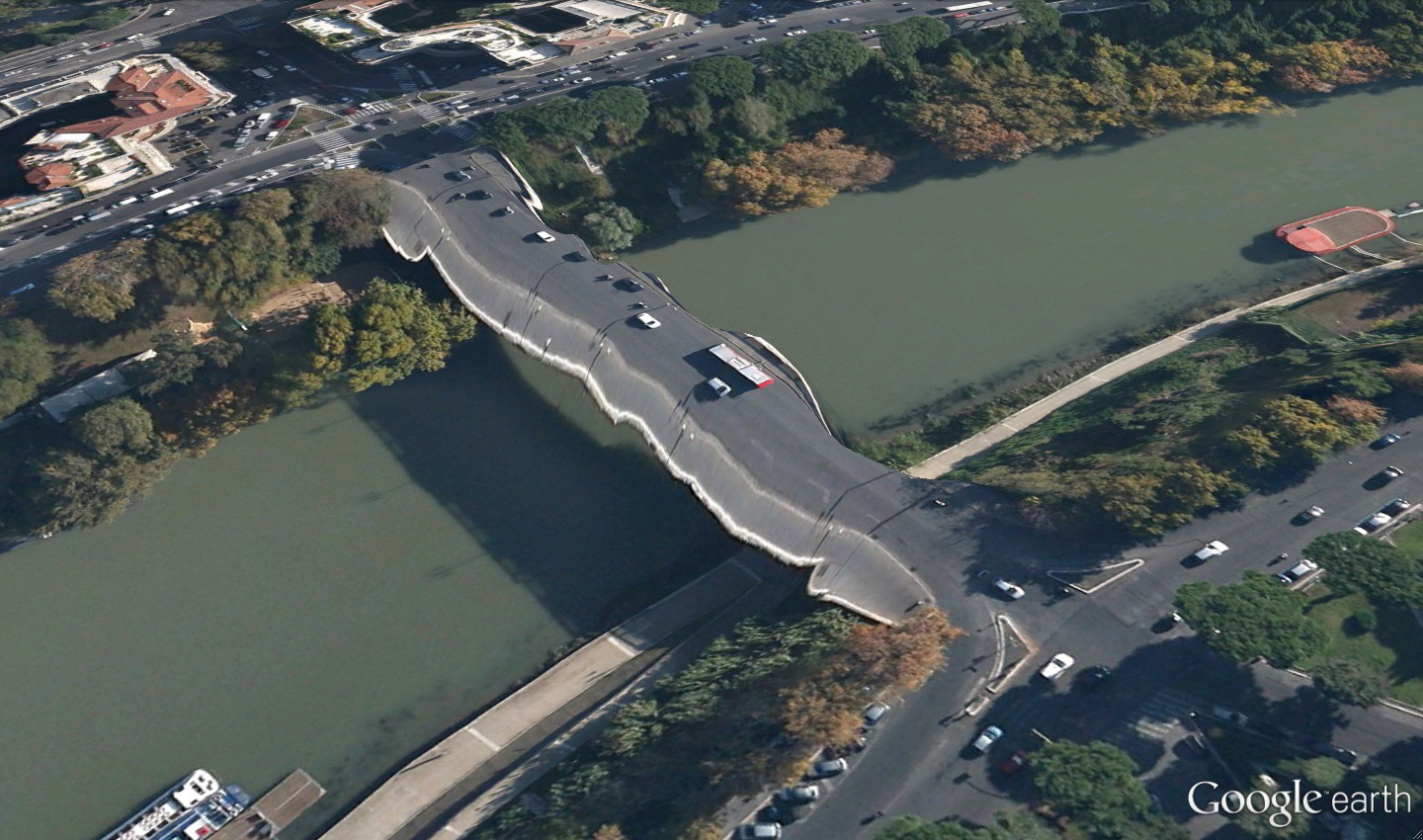
post_google1

In Postcards from Google earth the artist Clement Valla documents anomalies in the satellite imagery produced by Google. Essentially, these are artefacts produced by the hybrid of algorithms used by Google for marrying the planar photographic imagery generated by its satellites and the complicated topology of the surface of the earth. In truth, the failing is perceptual – we read depth cues in the photographs that the algos don’t. Yet. Google call this the Universal Texture. These images seem to me fulfil the wilder aims of the cubists, to visualise two distinct spatial perspectives in the same plane. We might also think these with De Certeau, as a totalizing representation of space achieved from a godlike perspective.
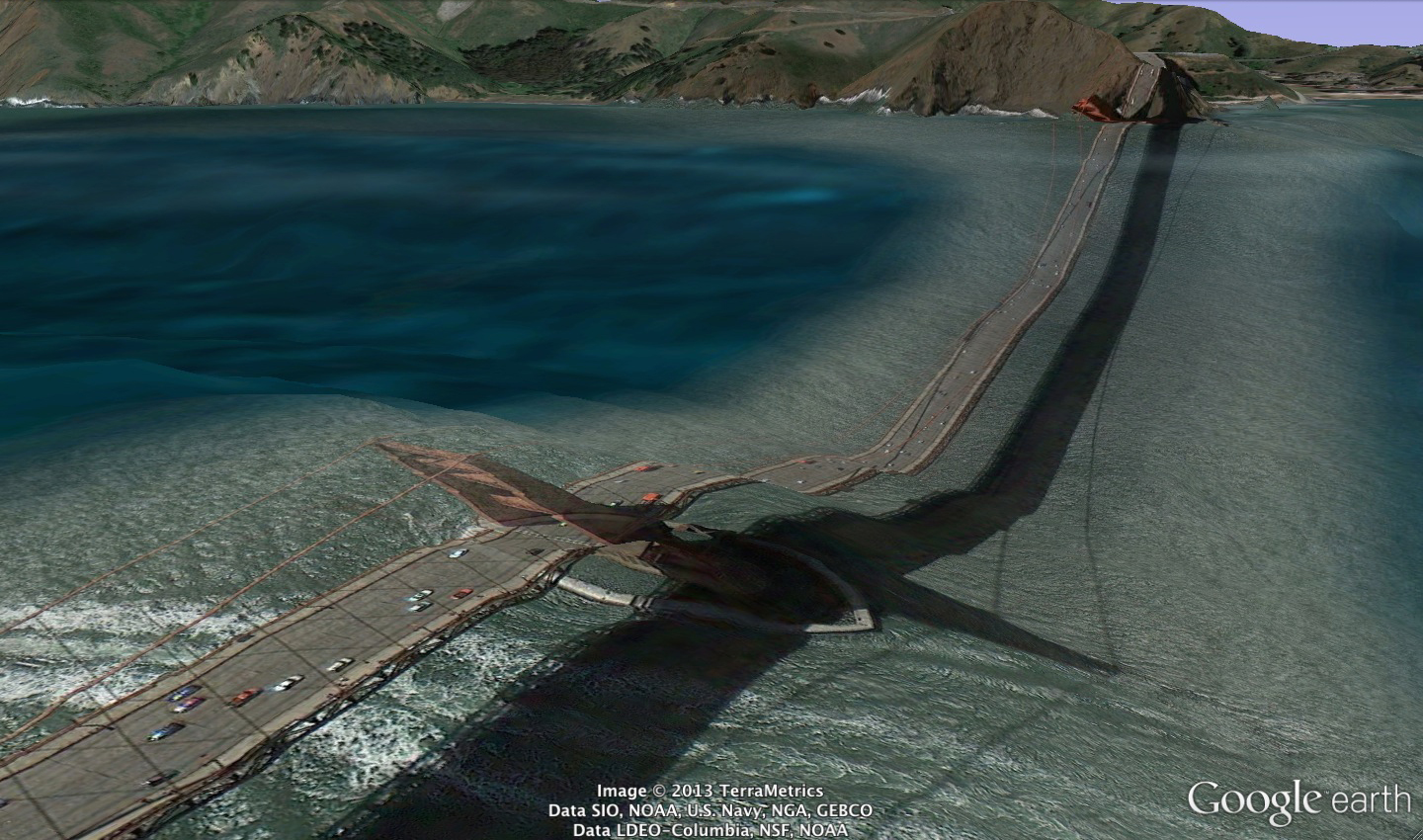
post_google2

I wonder if this form of noise, produced through a corporation processing impossible volumes of information, doesn’t map a new projective landscape into which literature and anthropology might strike, into which we might follow De Certeau’s calls to return to street street level. To what new islands might these roads take us? And more importantly, what kinds of subjects might inhabit them?

Satin Island

vanuatu-travel-diary

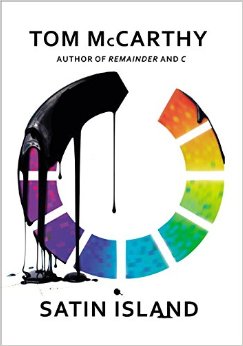
The reviews of Satin Island have started coming out and Tom McC’s doing the rounds and, characteristically, offering us ways to read his new novel.

Seems like the appropriate time to dive in. I’m not entirely disinterested: indeed, I’m actively interested. I’ve an essay on Tom’s work coming out in the collection Calling All Agents, edited by the quietly brilliant Dr Dennis Duncan, which will be published later this year (?) and of the writers who’ve generously blurbed my novel, Tom is the only one I’ve met. I’m also involved in an event that Tom’s curating that I don’t think I can announce yet, but which will happen before the end of the month. That will involve a more para-academic response to some of Satin Island’s themes.

So it’s safe to say I’m an enthusiast for the work. That’s a slightly double-edged sword: it can mean that one awaits a new book with trepidation, particularly when the last was a success. The reasons I enjoyed Satin Island should be evident from the below, but I want to headline it with a couple of observations. First: this is an incredibly generative novel. By creating an oil spill of the thought that informs his work – a spiral? a taffy-kneeding engine? – McCarthy creates a nexus of proliferation, prompts a super-abundance of readings. I love this. It’s surely a characteristic of great work. Second, McCarthy is a public intellectual of the kind that is very rare in this country: one who takes continental philosophy, and literature, very seriously; who navigates between the Scylla of the middlebrow and the Charybdis of pretentious, mystical bollocks with a sharp eye on the compass. Huge power to that.

A new novel by Tom McCarthy is certainly an ‘event’ round these ends, then, though not perhaps in the way its author might conceive that term.satin

The background: the publishing industry that initially ignored his debut Remainder  – now routinely referred to as a ‘cult’ book or a ‘masterpiece’ – has taken rather more notice since Zadie Smith claimed it as exemplary of one of the paths the English language novel might follow were it to turn away from ‘sentimental realism.’ The Man Booker Prize short-listing of C in 2012 was significant: it’s not that sentimental realism had been overturned, rather that the UK’s pre-eminent literary prize was willing to recognise a book that wasn’t that. There’s a film of Remainder coming out this year, directed by the visual artist Omer Fast. For those who enjoy the more conceptual or theoretically-led variant of the novel the positive reception of McCarthy’s work has been an undeniably good thing.

To recap on the novels so far: Remainder, the slow-burn/overnight breakthrough about a man who obsessively reconstructs events from a past made inaccessible to him through a neurological injury and which closes with a set-piece responding to a thought experiment sketched by Jean Baudrillard. Men in Space, based on an earlier manuscript returned to after Remainder, set primarily in Prague and Amsterdam, where McCarthy worked as an art critic in the 1990s, and concerning the forgery of a Russian icon. (Men in Space is frequently overlooked or under-rated – it might, in fact, be my favourite). C: the explicitly Modernist period book, a kind of Thomas Mann bildungsroman describing the life of Serge Carfax in four parts, the densely cryptic style of which makes it seem in retrospect more like a tribute to Joyce.

This is already a singular body of work and its interest to scholars of contemporary literature was recognised when it was made the subject of a conference at Birkbeck College, University of London, in 2012. Part of the singularity surely derives from McCarthy’s background in conceptual art. The first time a national newspaper took notice of him he apparently paid for the space: there are images of a front page ad in The Times for his fictitious avant garde art network The International Necronautical Society that seems to mimic the publication of Marinetti’s Futurist manifesto in Le Figaro in 1909. Try to find it in the Times Digital Archive and you’ll struggle: the image is a post hoc mock up. The rationale behind pretending to copy the actions of a movement that insisted upon its radical vanguardism can be found in Satin Island’s narrator’s account of his interest in parachute deaths: ‘an originally un-original event becoming even more un-original, and hence even more fascinating.’

McCarthy has maintained the INS alongside long-term collaborator, philosopher Simon Critchley, who published his own debut novel, Memory Theatre, last year. The INS is commissioned for installations and presentations at galleries around the world and the two have, on occasion, sent actors in their places. McCarthy won an inaugural 2013 Windham Campbell Literature Prize, awarded by Yale: that appears to be for real. A new novel from Tom McCarthy is certainly an event: it might not send ripples backwards and forwards through the continuum of history in the way that the ‘event’ as theorised by Alain Badiou does, but it does register with Newsnight.

Satin Island is narrated by U., a corporate anthropologist working for a company that is engaged at the bleeding edge of the contemporary. U. made his name by going native in the club culture of the 1990s. This is a very pleasing detail: there were ethnographers who did just that, recognising the tribal nature of a culture that rapidly factionalised – Jungle, Drum’n’bass, Intelligent Drum’n’bass, Techstep, Hardstep, Drill’n’bass, Droll’n’bass –  and evidenced ritualistic behaviour in its use of holy sacraments and gatherings of mass communion. It happened. It doesn’t seem real – in fact, it seems like a parody of something that might have happened, like so much that is ‘actual’ today, but it did happen; it was real; it left documents.

U. is attempting to write a report. His brief is broad: the contemporary. He follows his obsessions, like the narrator of Remainder. He researches the deaths of parachutists whose ‘chutes have failed to open (the INS researched the deaths of surfers in shark attacks). He relates anecdotes from a canonical work of French structural anthropology, Claude Lévi-Strauss’s Tristes Tropiques. He has a girlfriend called Madison, with whom he has sex, a colleague called Daniel, who projects quasi-anthropological films onto the walls of his office, and a friend called Petr, who develops a cancerous growth and dies. His boss is called Peyman and he occasionally sounds like Bruno Latour, insisting that objects are ‘systems of relations’ (or maybe he sounds like Paul Rabinow, who is name-checked in the acknowledgements; or any of a number of theorists I haven’t read but perhaps you have). Peyman’s name indicates that he fulfils the magical function of making the money appear. In this sense, this is McCarthy’s second novel in the fantastic tradition, in which he magics up the narrative cash to enable his protagonists to do what they want. Vanishing pecuniary concerns like this feels both terribly mundane and entirely radical: they’d simply get in the way of the business at hand. And what is that?

Well, it’s not characterisation, if by that you assume characters who communicate to the reader the rich range of their emotions. U. doesn’t feel a lot. In fact, he doesn’t feel anything. He thinks, becomes obsessed with topics of thought, loses interest in them, and thinks some more. Events don’t really connect with him: Petr’s funeral registers only because it seems as if the presiding vicar has no idea who the deceased really was, an experience that may well be familiar to readers who’ve been to more than one funeral. This is typical of a McCarthy protagonist: C’s Serge was the same.

The things that do register are more difficult to pin down; they’re abstract but material: taffy, parachutes, growths, caoutchouc, islands of waste; lumps of matter in abstracted form. I’m tempted to think of these as ‘unforms,’ stuff that represents that which is beyond thought – we might want to route direct to the INS’s primary research area here. These forms profoundly affect U.:

‘I’d stood rooted to the pavement in front of a candy store window in which taffy was being pulled, transfixed by the contortions of the huge, unmanageable lump (what child could eat all that?) as the machine’s arms plied it, it’s endless metamorphoses in which, despite the regular, repeating movements that stretched and folded, stretched and slapped the taffy through the same shapes over and over again, I knew, even then, that no part of it, no molecule, would ever occupy the same spot in the overall formation twice.’

Stylistically there is more that recognisably coheres with the first two novels than with C, in which the author’s native style was suppressed in the service of intensely cryptic signification. There’s an attitude that I want to call punk, but is possibly more aptly post-punk: fizzing, intelligent, spiky and built on a kind of reconstructed groove. He re-animates theory making it sound dangerous and sexy again then defuses it with a throwaway ‘y’knowwaddamean?’

‘This cataclysm, [Levi-Strauss] says, is the true face of our culture – the one that’s turned away, from us at least. The order and the harmony of the West, the laboratory in which structures of untold complexity are being cooked up, demand the emission of masses of noxious by-products. What the anthropologist encounters when he ventures beyond civilization’s perimeter-fence is no more than its effluvia, its toxic fallout. The first thing we see as we travel around the world is our own filth, thrown into mankind’s face.’

The writing is sharp, funny, and while not, perhaps, as obscurely signifying as in C, makes abstract ideas readily accessible: this alone is no mean feat of authorship.

Perhaps the greatest departure from the preceding works is that the philosophers and literary theorists who so inform McCarthy’s project have now broken cover and are named and referenced in the text. Previously, while McCarthy would delight in turning to Barthes or Blanchot in his interviews and essays, and paid tribute to post-structuralist literary criticism through his reading of Herge in Tintin and the Secret of Literature, the novels have subsumed their theory. Sure, it’s there if you’re so minded to see it but you can read them perfectly happily without it. The open references to Lacan et al. in Satin Island are sure to be divisive. Broadly speaking, literary fiction publishers have tended to be somewhat squeamish about the wacky French stuff that so dominated the Eng Lit academy in the eighties and early nineties, the reading public even more so: J. G. Ballard, perhaps the British novelist who shared the most intellectual territory with the enfants terrible across the channel, put some distance between himself and Baudrillard when critics compared them (though that never quite rang true and sure enough, dig a little deeper, and you’ll find Ballard recommending Baudrillard later in his career – turns out you can’t always take these novelists at their word).

Kathy Acker and Stewart Home were plagiarising Marx and the Situationists in the early nineties but they didn’t enjoy the crossover success McCarthy has. It can feel as if there’s been something like a collective sigh of relief in literary publishing that the academy has since tended towards the New Historicism that rose in the 1990s. Now we can get back to our Ian Fleming reboots and our life-affirming tales of bien pensant liberal existence without having to ignore the elephant in the room. This is evidently a reductive account of a complex field but, for the most part, so it has gone. It will be fascinating to see how Satin Island’s theoretical swagger is received.

There are a number of superb set piece scenes that lighten the texture of Satin Island. Two stand out in my mind. In the first, U. describes an extended daydream in which he gives a rapturously received conference paper. It’s a bravura piece of comic writing – almost classical in rhetorical construction – that reminded me of Jean Phillipe Toussaint’s Television, another book about an academic struggling to write a book. Once that realisation took hold, I thought, ‘This is his Toussaint book,’ but it wasn’t long before I came to the next set piece, when Madison describes her torture at the hands of Italian police following the 2001 G8 demonstrations in Genoa. This time I thought: ‘The Atrocity Exhibition – it’s Ballard.’ At other points you might think: ‘Pynchon’ or ‘Delillo’. There’s an obvious Melville lift, plentiful direct inter-textual references to the likes of Deleuze and, indeed, the author’s own body of work (the plane that causes delays at Torino Caselle airport is behaving erratically in airspace above London, doubtlessly flying in a figure-of-eight holding pattern as at the end of Remainder). These intra-corporal references come thick and fast in the final chapter giving a sense of Satin Island as a kind of summary report of the author’s work to date.

This also prompts the broader realisation that we’re always engaged in McCarthy’s game of source spotting. Indeed, he explicitly invites us to engage in this game in the acknowledgements:

Satin Island, like all books, contains hundreds of borrowings, echoes, re-mixes and straight repetitions. To list them all would take up as much space as the text itself. The critical reader can entertain him- or herself tracking some of them down, if he or she is that way inclined.’

So what does it mean to send readers to chase down these inter-textual references? Is it a quintessentially post-modernist move, in the manner of Alasdair Gray’s ‘Index of Plagiarisms’ running as a sidebar to the Epilogue of Lanark? Are we to feel the rug pulled from under our feet, to be drawn into undeniable realisation of the material object in our hands and its relation to other such material objects? McCarthy has written recently in the London Review of Books about the relationships between the vexed convention of literary realism and various philosophical approaches to the real. He’s keenly aware of the mimetic limits of the novel form and just as interested in the limits of perception and reason when it comes to the extra-textual real. Source-spotting surely is a game but it is also an enactment of the broader concerns of the project and a model for a very contemporary relationship with texts. Back in the late sixties, if you read Cortzar or The Atrocity Exhibition, you were probably in a minority. Those of us who grew in in the ’80s with Ian Livingstone’s fighting fantasy make-your-own-adventure books had a presentiment of how things might play out, albeit still anchored in the wood-pulp-based form. We’re all hypertext readers now.

Madison’s story leaps out as what we might think of, following the master-text for this section, as a ‘module.’ She’s being instructed to strike poses for a man according to signals he appears to be receiving from some kind of oscillator. She follows commands and the operator achieves moments of transcendent aesthetic pleasure that he registers with non-sexual moans and groans and eventually sobs. He even begins to mimic her movements with his own. Madison thinks she can discern children’s voices in amongst the tones emitted by the oscillator but when the machine comes to rest she realises that the children’s voices are noises off, coming from outside the room.

McCarthy’s work is particularly focused on an informational reading of literature, informed by the post-structuralist canon but hybridised with media theory (he wrote a short obituary piece for the LRB on the death of Friedrich Kittler expressing a genuine surprise and joy that Kittler had recognised his work). Drawing on such informational thinking, in this tableau we might see Madison as the reader and the policeman as the novelist. The reader reads both signal (the sources and references drawn on by the novelist) and noise (her own field of reference) and makes sense of the resulting melange. The novelist attempts to manipulate his own signal-making machine in contract with the reader and sometimes they strike a balance of form and communion. It’s all a stylised dance, with a terrible absence at its origin – in this instance, the absence of a traumatic real that is merely suspended; an electric shock from a cattle prod. Reading this chapter, a story that might be providing a structural model of the reciprocal relationship between reader and author, you experience a rush of revelation and then you realise that your revelation is just like one you read U. experiencing some thirty pages previously. You’ve been manipulated into your eureka moment. The rush fades, just as U.’s did. It’s all bullshit. And so on. Turtles all the way down.

This is, of course, just one possible reading of the tableau. We could re-arrange it so that the structure provides something else. It’s ambiguous, a structure that invites interpretation in a text that provides too many answers: another reviewer will surely examine a different passage and yield different results. That’s the game we’re playing, the dance on which we’re being led. Break out your own moves – spasmodic, angular Ian Curtis twitches, perhaps – and you may yet see them mirrored back at you, but so will the woman over there doing spins like she’s at a Northern Soul all-nighter; and that guy lost in his classical ballet. This is reader reception theory routed through informational redundancy.

The dance alone might be interesting – it’s certainly led with great skill – but would it be enough? (There are, of course, those who don’t like dancing to any tune, but, y’know, their loss). A straight repetition of the nouveau roman or classic Pynchon would not be as interesting as McCarthy’s dictum claims and he knows it. What makes McCarthy’s work so exciting is that it does indeed push beyond the texts that it identifies as its sources. Unlike the academy, McCarthy is plunging headlong back into deconstruction with the aim of emerging on the other side – or perhaps bouncing back again. How can you acknowledge the fallibility of language, multiplicities of readings and reclaim the inauthenticity of literature within the body of literature itself?

Right at the heart of the narrative there’s a story from Tristes Tropiques about Lévi-Strauss leaving a tribe he understands too well and landing at another he can’t get any purchase on at all:

‘But maybe, just maybe, he reasons, somewhere in between two extremes – in between understanding so completely that an object’s robbed of its allure (on the one hand) and (on the other one) not understanding anything at all – there might be some “ambiguous instances” in which the balance is just right.’

This is, perhaps, Satin Island’s response: develop the ambiguity. Incorporate the stuff, the goo, the warping and wefting residue, the children’s voices: throw up so much noise surrounding the signal, set up your own feedback loops and fields of distortion. Get the balance just right and we dance together to postpone the cattle prod.

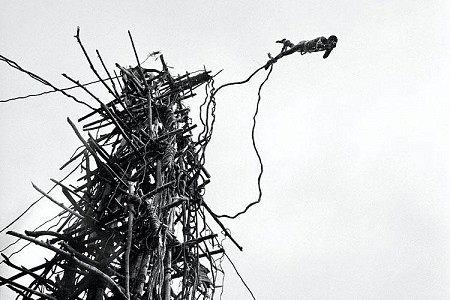
Satin Island enacts its theory. It’s cunning, it’s terrific fun and it’s very serious. I felt like one of the Vanuatans who so interest U., pioneers of bungee-jumping and productive mis-interpreters of signal and noise. I almost hit the ground but I bounced right back up, invigorated by a mediated brush with the field of the contemporary and ready to jump again.